
How Much Will $1000 Grow in 10 Years? Investment Growth Explained
Understanding how much will $1000 grow in 10 years is an important step in smart financial planning. Many beginners want to know whether a small amount like $1,000 can grow significantly through investing. The answer depends mainly on compound interest, the rate of return, and where the money is invested.
When money earns interest or investment returns, those earnings begin to generate their own earnings. This process is called Compound Interest, and it is one of the most powerful ways to grow savings over time.
Understanding Compound Interest
Before calculating the future value of $1000, it is important to understand how compound interest works. Unlike simple interest, compound interest allows your initial investment and its accumulated earnings to grow together.
For example, if you invest $1,000 and earn 7% per year, you earn interest on the original $1,000 in the first year. In the second year, you earn interest on $1,070, not just the initial amount.
This continuous compounding leads to exponential growth, which explains why long-term investing is such an effective wealth-building strategy.
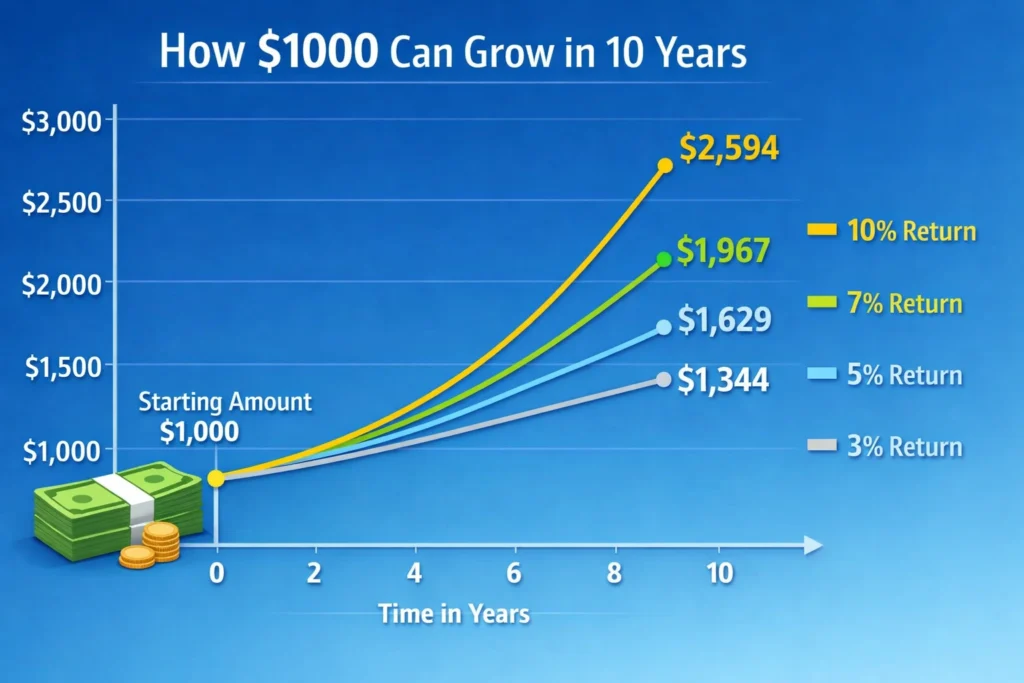
Future Value of $1000 After 10 Years
The future value calculation depends on the expected annual return. Below are common investment return scenarios that show how much $1000 could grow in 10 years.
| Annual Return | Value After 10 Years | Total Growth |
| 3% (Savings) | $1,344 | $344 |
| 5% (Conservative Portfolio) | $1,629 | $629 |
| 7% (Index Funds Average) | $1,967 | $967 |
| 10% (Strong Stock Market Return) | $2,594 | $1,594 |
These examples show how investment growth of $1000 over time depends heavily on the return rate. For instance, at 7% compound interest, the future value of $1000 becomes about $1,967 in 10 years.
Different Investment Return Scenarios
Investors often place $1,000 in different assets to achieve varying returns. Some common options include:
1. Savings Account
A traditional savings account offers safety but usually low returns. At around 2–3% interest, the $1000 savings growth remains limited over a decade.
2. Index Funds
Index funds track market indices and historically return about 7–10% annually. Investing $1,000 here can produce strong 10 year investment return potential.
3. Mutual Funds
Actively managed mutual funds may generate moderate to high returns depending on the portfolio strategy.
4. Stock Market Investing
Direct stock investments can produce higher returns, but they also carry higher risk. Diversifying across an investment portfolio can improve long-term stability while maintaining growth potential.
Investment Growth Calculator and Financial Planning Tools
A compound interest calculator or investment growth calculator helps estimate the future value of $1000 with interest quickly. These financial planning tools allow you to adjust:
- Interest rate
- Investment duration
- Additional monthly contributions
- Compounding frequency
Using such tools makes it easier to compare different investment return scenarios and choose the best strategy.
Inflation and Real Investment Returns
One important factor many investors overlook is inflation. Inflation reduces the purchasing power of money over time. If inflation averages 3% per year, the real return of your investment becomes lower.
For example:
- 7% return – 3% inflation = 4% real return
This means your $1000 investment growth still increases, but the real value grows more slowly.
How to Turn $1000 Into More Money in 10 Years
If you want to maximize the $1000 investment return after 10 years, consider these strategies:
- Invest early and allow compounding to work
- Choose diversified index funds
- Reinvest dividends
- Avoid withdrawing profits early
- Add regular contributions when possible
Even small additions to the initial investment can dramatically increase long-term growth.
Is $1000 Enough to Invest?
Yes, $1000 is enough to start investing. Many successful investors began with small amounts. What matters most is consistency and time in the market. The key goal is to grow your return on investment (ROI) through disciplined investing and patience. Over time, even a modest initial investment can become a meaningful part of a long-term wealth-building strategy.
Frequently Asked Questions
1. How much will $1000 be worth in 10 years at 7%?
At a 7% annual compound return, $1,000 grows to approximately $1,967 in 10 years.
2. How much will $1000 grow in 10 years with compound interest?
Depending on the rate, $1,000 can grow to $1,344 to $2,594 over 10 years using compound interest.
3. What is compound interest?
Compound interest means earning interest on both the original investment and the accumulated interest, which accelerates long-term growth.
4. Where should I invest $1000 for the best return?
Popular options include index funds, mutual funds, ETFs, and diversified stock market portfolios.
5. How fast does $1000 grow in the stock market?
If the market averages 7–10% annual returns, $1,000 could nearly double in about 10 years due to compound growth.

Hi, I’m Rocky — a finance enthusiast and tech-minded writer at FinanceToolfy.com, where I help readers navigate the ever-evolving intersection of money and technology.
With a graduate-level education under my belt, I bring an analytical and research-driven perspective to everything I write. Whether I’m breaking down complex financial concepts, reviewing the latest fintech tools, or sharing practical money strategies, my goal is always the same — to make finance accessible, actionable, and genuinely useful for everyday people. Read More






One Comment